Table Of Content

Get Mark Richards’s Software Architecture Patterns ebook to better understand how to design components—and how they should interact. Take O’Reilly with you and learn anywhere, anytime on your phone and tablet. O’Reilly members experience books, live events, courses curated by job role, and more from O’Reilly and nearly 200 top publishers.
Interface for Processes
An abstract factory offers the interface for creating a set of related or dependant objects without explicitly specifying their classes. Most behavioral design patterns are specifically concerned with communication between objects. An object with methods to create objects without specifying the exact class that will be created. Depending on the concrete factory implementation objects with different classes are created.
Search code, repositories, users, issues, pull requests...
This practise is particularly useful when the construction of a new object is inefficient. The memento pattern is used to capture the current state of an object and store it in such a manner that it can be restored at a later time without breaking the rules of encapsulation. The interpreter pattern is used to define the grammar for instructions that form part of a language or notation, whilst allowing the grammar to be easily extended. The facade pattern is used to define a simplified interface to a more complex subsystem. A decorator allows to add behavior to an individual object, either statically or dynamically, without affecting the behavior of other objects from the same class. Instead of using numerous constructors, the builder pattern uses a builder object, that instantiates and initializes objects using a multiple of steps.
Keep Learning
Dive in for free with a 10-day trial of the O’Reilly learning platform—then explore all the other resources our members count on to build skills and solve problems every day. Using inheritance is recommended mainly when adding to the functionality of existing components, reusing most of the old code and adding relatively small amounts of new code. Many programming concepts are inspired by the physical world we live in. The advantage of this technique is that the requests can be queued, logged or implemented to support undo/redo.
What is the Adapter Design Pattern?
The clients can access and use individual objects and compositions in the same manner. The chain of responsibility pattern is a design pattern that defines a linked list of handlers, each of which is able to process requests. When a request is submitted to the chain, it is passed to the first handler in the list that is able to process it. Patterns are more like receipts – they point you to right direction but they don’t guarantee that they are the solution you are looking for. Same way you use receipts in cooking book – you know what you want, book gives just points you to right direction and it is up to you to get there. The mediator pattern is used to reduce coupling between classes that communicate with each other.
More light-hearted criticism has included a show trial at the 1999 OOPSLA meeting,[11] and a parody of the format by Jim Coplien entitled "Kansas City Air Conditioner". The book started at a birds-of-a-feather session at the 1990 OOPSLA meeting, "Towards an Architecture Handbook", where Erich Gamma and Richard Helm met and discovered their common interest. They were later joined by Ralph Johnson and John Vlissides.[6] The book was originally published on 21 October 1994, with a 1995 copyright, and was made available to the public at the 1994 OOPSLA meeting.
Table of Contents
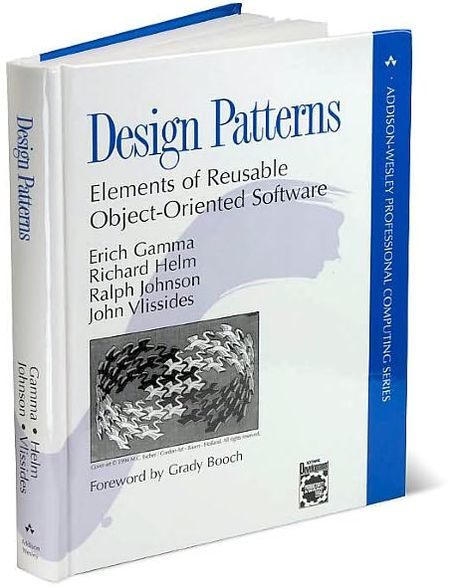
Each pattern also includes code that demonstrates how it may be implemented in object-oriented programming languages like C++ or Smalltalk. N2 - Capturing a wealth of experience about the design of object-oriented software, four top-notch designers present a catalog of simple and succinct solutions to commonly occurring design problems. Each pattern describes the circumstances in which it is applicable, when it can be applied in view of other design constraints, and the consequences and trade-offs of using the pattern within a larger design. Patterns allow designers to create more flexible, elegant, and ultimately reusable designs without having to rediscover the design solutions themselves. Design Patterns is golden classics of software design books written by Erich Gamma, Richard Helm, Ralph Johnson and John Vlissides (aka Gang of Four – GoF). When this book was published first it was revolutionary because it contained still undocumented knowledge from software development field that needed some systematic work and organization on it.
A. Leftover Patterns - Head First Design Patterns, 2nd Edition [Book] - O'Reilly Media
A. Leftover Patterns - Head First Design Patterns, 2nd Edition .
Posted: Wed, 22 Sep 2021 21:19:37 GMT [source]
AB - Capturing a wealth of experience about the design of object-oriented software, four top-notch designers present a catalog of simple and succinct solutions to commonly occurring design problems. They then go on to systematically name, explain, evaluate, and catalog recurring designs in object-oriented systems. All patterns are compiled from real systems and are based on real-world examples.
Design Patterns: Elements of Reusable Object-Oriented Software - 1st Edition.pdf
If you are unfamiliar with these concepts, please check out my article on SOLID Principles in Flutter Development. The flyweight pattern is used to reduce the memory and resource usage for complex models containing many hundreds, thousands or hundreds of thousands of similar objects. UserAPI returns JSON data directly, while EmployeeAPI returns XML data.
The XMLToJSONAdapter class is used to convert the XML data from EmployeeAPI into JSON format, making it compatible with the rest of the system that expects JSON data. Suppose you have a music player in your car that only supports cassettes, but you want to listen to music from your smartphone. The adapter has an interface compatible with the cassette player and provides an interface for your smartphone to use. The prototype pattern is used to instantiate a new object by copying all of the properties of an existing object, creating an independent clone.
It provides greater flexibility and reusability of existing code, making it simpler to integrate new classes with old code. However, like any design pattern, it needs to be used carefully, considering the possible pitfalls and the complexity it can add to the codebase. If you find my articles useful, do connect with me on LinkedIn to share your thoughts that motivate me. Explore the Adapter Design Pattern, a popular structural design pattern in software development. Learn its definition, real-world examples, appropriate use cases, potential pitfalls, and more.
18 Best Software Engineering Books - Built In
18 Best Software Engineering Books.
Posted: Wed, 24 May 2023 16:01:25 GMT [source]
According to the book "Design Patterns, Elements of Reusable Object-Oriented Software," the Adapter design pattern converts the interface of a class into another interface clients expect. The adapter lets classes work together that couldn't otherwise because of incompatible interfaces. The adapter design pattern, also known as Wrapper, is a popular structural design pattern in software development. If you're unsure what a design pattern is, have a look at my earlier articles on the design pattern series.
Use of an interface also leads to dynamic binding and polymorphism, which are central features of object-oriented programming. The state pattern is used to alter the behaviour of an object as its internal state changes. The pattern allows the class for an object to apparently change at run-time. The composite pattern describes a way to create tree structures using objects and object groups.
Instead of classes communicating directly, and thus requiring knowledge of their implementation, the classes send messages via a mediator object. When I see patterns in my programs, I consider it a sign of trouble. The shape of a program should reflect only the problem it needs to solve.
The proxy provides the same public interface as the underlying subject class, adding a level of indirection by accepting requests from a client object and passing these to the real subject object as necessary. The authors employ the term 'toolkit' where others might today use 'class library', as in C# or Java. In their parlance, toolkits are the object-oriented equivalent of subroutine libraries, whereas a 'framework' is a set of cooperating classes that make up a reusable design for a specific class of software. They state that applications are hard to design, toolkits are harder, and frameworks are the hardest to design. They warn that the implementation of a subclass can become so bound up with the implementation of its parent class that any change in the parent's implementation will force the subclass to change. Furthermore, they claim that a way to avoid this is to inherit only from abstract classes—but then, they point out that there is minimal code reuse.


No comments:
Post a Comment